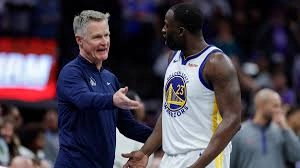
Four NBA titles, four All-Star selections, and nine All-Defensive teams later, Draymond Green says he wonders if he could have done even more during his illustrious NBA career, and he points to his relationship with Golden State Warriors head coach Steve Kerr as a factor that may have hindered his development and limited his potential in ways that are only now becoming clear. The revelation from Green is a stunning and unexpected twist in the story of one of the most successful player-coach partnerships in NBA history, a relationship that has produced four championships and helped define an era of Warriors basketball that will be remembered as one of the greatest dynasties in the history of professional sports. Green's willingness to speak candidly about the complexities of his relationship with Kerr is a testament to his honesty and his desire to share the full picture of his NBA journey, even when that picture includes elements that are uncomfortable or surprising.
Green's comments about Kerr are not a condemnation of the coach or the system that the Warriors have built over the past decade, but rather a nuanced and thoughtful reflection on the ways in which the demands of playing within a structured system can sometimes limit a player's individual expression and development. Green has always been a player who thrives on emotion, intensity, and instinct, and there have been times throughout his career when the structured, ball-movement-oriented offense that Kerr prefers has felt constraining to a player whose natural inclination is to create and improvise. The tension between Green's instinctual style of play and Kerr's systematic approach has been a source of both friction and creativity throughout their partnership, and it is this tension that Green is reflecting on when he suggests that Kerr may have hindered his career in certain ways.
The irony of Green's comments is that the very system that he feels may have limited his individual statistics and accolades is the same system that enabled him to win four championships and establish himself as one of the most important and influential players of his generation. Kerr's offensive system, which prioritizes ball movement, spacing, and unselfish play, has been the perfect vehicle for Green's unique skill set as a playmaking forward who can facilitate the offense from the center position. Without Kerr's system, it is entirely possible that Green would never have developed into the Defensive Player of the Year and All-Star that he became, as the Warriors' style of play maximized his strengths and minimized his weaknesses in ways that a more traditional offensive system might not have. The question of whether Green could have been even better in a different system is an interesting one, but it is ultimately unanswerable, and the four championship banners hanging in the Chase Center rafters are a powerful argument for the effectiveness of the Kerr-Green partnership.
Green's willingness to publicly discuss the tensions and complexities of his relationship with Kerr is a reflection of the maturity and self-awareness that he has developed over the course of his career. Early in his career, Green was known for his fiery temperament and his tendency to let his emotions boil over in ways that were sometimes detrimental to himself and his team. But as he has aged and matured, Green has learned to channel his intensity more productively and to express his frustrations and concerns in ways that are constructive rather than destructive. His comments about Kerr are not an attack on his coach but rather an honest assessment of the trade-offs that come with playing in a structured system, and they demonstrate a level of introspection and candor that is rare among professional athletes of his stature.
As Green continues to reflect on his career and his legacy, the conversation about his relationship with Kerr and the impact it has had on his development will continue to be a topic of fascination for NBA fans and analysts. The truth is that the Kerr-Green partnership has been one of the most successful and consequential in NBA history, and the four championships they have won together are a testament to the power of their collaboration, even when it has been marked by tension and disagreement. Green's comments are a reminder that even the most successful partnerships are not without their complications, and that the path to greatness is rarely smooth or straightforward. Whether Kerr hindered Green's career or helped him reach heights he never would have achieved on his own is a debate that will never be definitively settled, but the legacy they have built together in Golden State is beyond dispute.